My Workbench
Showing posts with label Langton. Show all posts

Monday, September 14, 2026

1/1200 Langton HMS Caesar 80-Gun Ship

HMS Caesar was an 80-gun third rate ship of the line of the Royal Navy. She was laid down at Plymouth in 1786 and launched in 1793 when the wars with France began. The Caesar and the Foudroyant were the first British 80-gun warships to be built for nearly a hundred years, and no more would be ordered for two decades.

Designed by Sir Edward Hunt, HMS Caesar was measured at 2,002 tons, 181 feet in length, with a 50 foot beam. Mounting 80 guns of varying caliber, including a main armament of 30-32pdrs. Her initial compliment consisted of 719 officers and men. Her completion - as the first such English warship in a century - even inspired a contemporary play "The Launch of the Caesar, of Trip to Plymoth Dock" to celebrate the event.

  • Gundeck: 30 x 32 pdrs
  • Upper Gundeck: 32 x 24 pdrs
  • Quarterdeck: 14 x 9 pdrs
  • Forecastle:4 x 9 pdrs

The ship participated in several battles during the Napoleonic Wars, including Lord Howe's victory over the French on June 1, 1794, the first naval engagement of the French Revolution, known as the Glorious First of June. Caesar's captain, Anthony James, face a courts marshal after the battle, accused of not doing his best to pass through the enemy line on May 29 and failing to take up his proper station on June 1. He was dismissed.

Caesar was the flagship of Vice-Admiral Charles Edmund Nugent (promoted to Admiral in 1822), operating in the Channel from 1795 until 1797.

Caesar was the flagship to Sir James Saumarez's squadron blockading Cadiz when the The Battle of Algeciras Bay ocurred on 6 July, 1801. The losses on both sides were heavy. The Caesar had 9 killed and 33 wounded or missing.

Six days later on the morning 12 July the combined French and Spanish squadron put to sea, followed closely by the British squadron. What followed was the Second Battle of Algeciras, sometimes referred to as the Gut of Gibraltar. 

On 30 April, 1802, near Gibraltar under command of Sir James Saumarez, Caesar made contact with USS Constellation on her way to Tripoli. 

On 4 November, 1805, a remnant of the fleet that had been destroyed several weeks earlier at the Battle of Trafalgar spotted by a British squadron under the command of Captain Sir Richard Strachan in Caesar. He gave chase and captured the French and Spanish squadron under Rear Admiral Perre Dumanoir le Pelley.

The Model:


Thursday, August 7, 2025

1/1200 Langton 74-gun HMS Hero

Next off the bench is a Langton middling 74-gun ship modeled as HMS Hero. HMS Hero was a Fame-class ship of the line.

1743 Tons (bm); Length on gundeck 175ft (53m); Beam 47ft 6in (14.48m); Depth of hold 20ft 6in (6.25m); Complement 530.

Armament 74 Guns: Gundeck 28 x 32 pounder long guns, Upper gundeck 28 x 18 pounder long guns, Quarterdeck 14 x 9 pounder long guns, Forecastle 4 x 9 pounder long guns. 


The following brief history is directly from Rootsweb Naval Database. 

HMS Hero

Type: 3rd rate ; Armament 74
Launched : at Messrs Perry's, Blackwall Thurs 18 Aug 1803 ;
Disposal date or year : 24 Dec 1811
Disposal Details : Wrecked, St George & Defence off the coast of Jutland, on passage from Baltic, Hero on the Haak sand, Texel : crew of latter perished, and both crews of former, except about eighteen men. Captain James Newman Newman
Notes:

18 Aug 1803 Hon Capt Gardner apptd in command of the Hero.

Circa 22 Oct 1803 Hon Capt Gardner apptd to the Hero.

27 Nov 1803 the Hero, Hindostan, Bonetta, and Volcano, will drop down from Woolwich to Long Reach, to take in their guns and powder, and wait only a fair wind to proceed to the Nore.

27 Nov 1803 departed Woolwich for Long Reach, to embark guns and powder &c.

Circa 17 Dec 1803 the Hero, Abundance, Zyphyr, and Glatton, have taken on board their powder and guns and only await a fair wind to drop down from Long Reach to the Nore to complete their complements, the latter having been ordered to Leith to receive the flag of R.-Adm Bligh.

10 Jun 1804 the Repulse, Capt Legge, and Hero, Capt Gardner, arrived Spithead from the North Sea Station, to be fitted for Channel Fleet.

20 Jun 1804 departed Spithead, the Hero, Hon Capt Gardner, to join the Channel Fleet.

15 Jul 1805 with the blockading squadron off Ferrol, under Sir Robert Calder : departed 30 to 40 leagues off Finisterre to intercept Franco-Spanish fleet from the West Indies. 22nd sighted each other. Signal made to engage the enemy - the engagement. The damage ; subsequent manoeuvres by the two fleets ; the wash-up ; 26 Jul 1805 movements of the fleet following the battle. (Battle of Cape Finisterre 1805)

Admiral Sir Robert Calder's Action off Cape Finisterre, 23 July 1805

29 Oct 1805 in search of the Rochefort squadron. 2 Nov Phoenix reported position of the French Squadron : the chase began. 3-4 Nov 4th, the frigates harass the French rear. The action. the French haul down their colours. Casualties. The frigates role in the action. Prizes taken to Plymouth and added to the Service. The honours, awards and promotions. (Battle of Cape Ortegal, under Captain Sir Richard Strachan)

Strachan's Action off Ferrol, by Thomas Whitcombe

3 Jan 1806 Sir J.B. Warren's squadron at St. Helen's, adverse winds preventing him sailing. 12 Jan departed for Madeira to gain intelligence of the French squadron under V.-adm. Leissegues.

4 Jun 1806 having returned from his first cruise departed from Spithead for the West Indies arriving Barbadoes 12 Jul with the Fame in lieu of the Repulse.

24 Feb 1809 later that day Rear-admiral Stopford's squadron returned to his station off the Chasseron lighthouse, and observed the squadron of M. Willaumez at anchor in Basque roads, and was joined on the 25th by Captain Beresford and his three ships, with his force thus augmented to seven sail of the line and five frigates, resumed the blockade of the port, with the Hero joining shortly afterwards.

7 Mar 1809 with Admiral Lord Gambier who relieved Rear-admiral Stopford's in command of the blockade of Basque Roads.

17 Mar 1809 anchored in Basque roads. 11 Apr the use of fire ships, explosion-vessels, and Congreve rockets against the French fleet at Basque roads and the results thereof.

Portsmouth 29 Dec 1809 arrived from the Isle of Walcheren.

21 Jul 1810, departed the homeward-bound Baltic convoy, of about 200 sail, off Rob's Snout, under the protection of the Lynx, Clio, Snake, Rosario, Gluckstadt, and Centinel, with the Tartar, Rose, and Primrose following at some distance astern, [presumably with a view to preventing enemy gun boats sneaking up from astern, and picking off the slower vessels in the convoy, a much favoured practice.]

Hull, 2 Oct 1810 the Mars and Hero are reported to have passed Yarmouth for the Thames with a fleet of 600-700 ships from the Baltic, 40-50 of them being prizes.

Plymouth Dock 6 Mar 1811 arrived from Basque Roads.

Plymouth 30 Mar 1811 Under orders to join the Baltic fleet.

Plymouth 4 Apr 1811 departed for Yarmouth.

Portsmouth 11 Apr 1811 departed for the Baltic.

Harwich 21 Apr 1811 Is reported to have made five captures in the Categut.

Leith 28 Dec 1811 arrived from Wingo Sound (18 Dec) with a convoy.

18-25 Dec 1811 the loss of the Hero, wrecked in a gale on the Haak sand off the Texel, and the Grasshopper, which drove over the bank close in with Texel island, resulting in her surrender to the Dutch.

The wreck of HMS Hero in the Texel 25 December, 1811


The Model:


Sunday, April 19, 2020

Langton 2 Gun Sloop

I haven't been able to get to the shipyard for several days now to finish this little Great Lakes sloop I started. Both our dogs are 15 years old this year and the little Aussie is on his last legs, literally. so the wife and I have been on watch, sitting with him constantly for the last four days. I haven't been able to get anything done.

She is on duty now so I rushed down to the shipyard to finished the sloop and post this.

This is Langton's two gun sloop, part of their Great Lakes War of 1812 line.
Unfortunately I am not sure what ship this could be. On Lake Erie there was a sloop on both the US and British sides. But the USS Trippe carried just one 24 pounder long gun and the HMS Little Belt had three guns, one 12 pounder long gun and two 6 pounder long guns.
I couldn't find record of any sloops on Lake Ontario at all.


With the 15 star US ensign:


With the Royal Navy red ensign:


I started working on one of the Warlord Games Black Seas frigates....but I was really getting into these little Great Lakes ships that I have had stored for so long.......No promises what the next post will be 😎

April 20 Update:

Brian W. wants me to explain how I swap out the flags so easily. Pretty simple really. I used to mat and frame art prints for a hobby. One of the tools I used was a mat adhesive gun to attach the cut mat to acid free foam core backing.

Adhesive gun, worth its weight in gold!

Adhesive tape cartridge

The tape has sticky adhesive on one side and when it is rolled against something it comes off of the tape and lays smooth on the surface you rolled it on. anything you press onto that surface will stick to it. But it is easily removed with some pressure and the adhesive can be removed by rolling it up with a thumb or finger. This sticky stuff is what I use to swap out flags. It almost never loses its adhesiveness unless it gets dirty. I just lifted a sliver of it and attached it to the line against the sail, then I gently press the flag edge to it and it is done. To remove just a gentle tug downward or upward and the flag comes away. The adhesive stays on the first surface it is applied to, the sail.

Sliver of rolled up sticky stuff to be removed

Flag on

Flag off showing sticky stuff

Flag back on
 So that's how I do it. I have dropped ships and not had the flags fall off, although I only do this to a few ships.

Thursday, April 9, 2020

Langton 11 gun Galley Washington

The next build during my pandemic incarceration is the Langton Continental galley Washington. This was a really nice model to build, as all Langtons are.

Model of Washington in the National Museum of the US Navy

The lateen rigged row galley was built by soldiers on Lake Champlain at Skenesboro, New York in the autumn of 1776. On October 6 Washington joined the small fleet put together and commanded by Brigadier General Benedict Arnold. Washington was commanded by Arnold's second in command, Brigadier General David Waterbury. She was anchored with the other small vessels in the lee of Valcour Island to await the expected British move.

Captain Thomas Pringle, of the Royal Navy, led a 25 ship fleet past Valcour Island on October 11. Pringle sighted the American fleet when he passed the island and attacked from leeward. In the ensuing action Washington suffered the most damage of any vessel in Arnold's fleet.

Arnold regrouped his shattered fleet and slipped past the British on October 12 with muffled oars in a desperate attempt at escape. However the British caught up the following day at Split Rock near Crown Point.

Arnold managed to beech and destroy four of the galleys and his own flagship, Congress, while most of the remaining ships escaped upriver. Only Washington, at the rear of the van, was captured by the enemy. According to Arnold, she struck her colors after receiving a couple of broadsides.

Washington was eventually taken into Royal service, retaining her name. She was re-rigged as a brig. Her fate is unknown.

Length 72' 4"; Breadth 19' 7"; draft of 6' 2"; displacement 123 long tons; Crew 80
Armament: 2 x 18 pounder long guns, 2 x 12 pounder long guns, 2 x 9 pounders, 4 x 4 pounders, 1 x 2 pounder, 8 x swivel guns

Information is from https://www.revwartalk.com/uss-washington-1776-lateen-rigged-galley/


Saturday, January 19, 2019

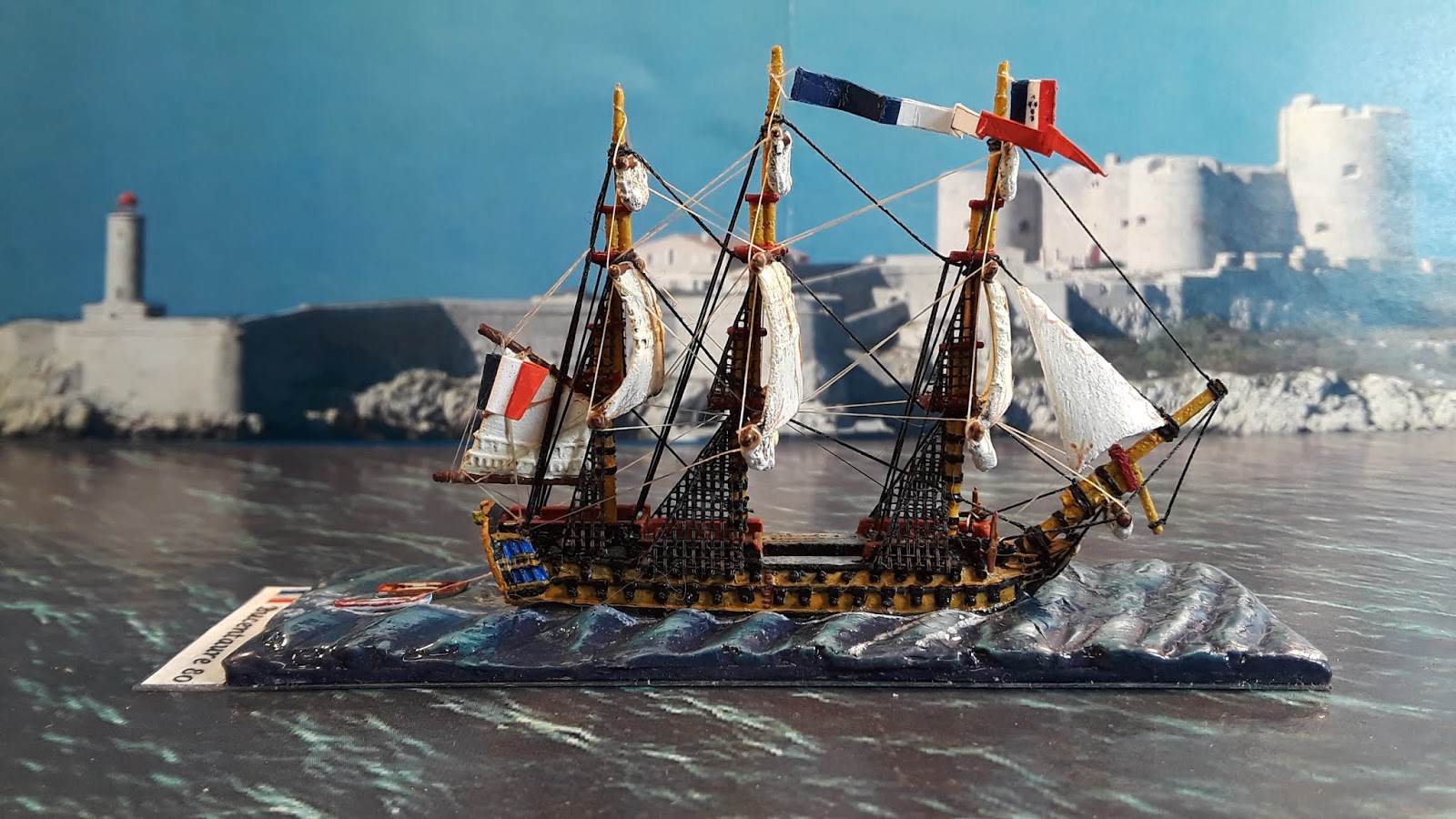
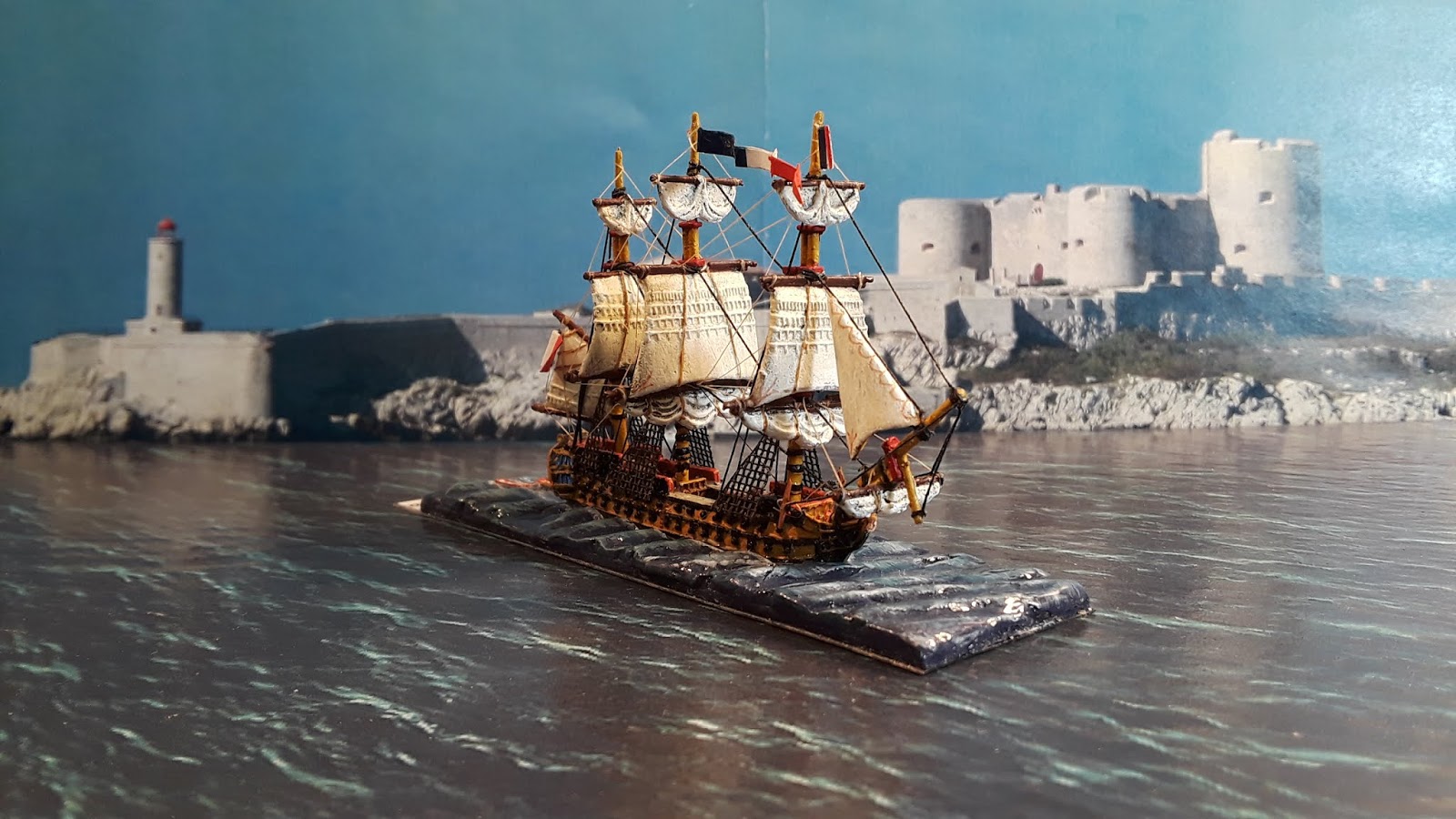
Langton 80 Gun French Third Rate Le Bucentaure


This ship is one of Langton's French 80 gun at quarters models with topsail and jib sail set. Nothing is scratchbuilt on this one except the base and ratlines. The anchors and ship's boats are GHQ.

Brief History:
Le Bucentaure was the first ship in the French navy to bear this name. Designed by Jacques Noel Sane, her lines were virtually identical to the 80 gun ships Indomptable, Formidable, and Neptune, which also fought at Trafalgar, as well as the captured Tonnant that fought with the British fleet. The two decked 80 gun ships employed in the French navy were far superior to the cumbersome three decked 80 gun ships previously used in the Royal navy. Bucentaure was launched at Toulon in 1803. She was blockaded in Toulon by the British fleet for the next few years until, as flagship of Vice-Admiral Pierre Charles Jean Babtiste Silvestre de Villeneuve, she broke out with the French fleet on the 17th of January 1805. Villeneuve's squadron comprised 20 vessels. The fleet was sighted a 6:30 PM by frigates that had remained on station. As the fleet sailed westward the weather deteriorated and scattered the fleet, compelling Villeneuve to return to Toulon. On March 29 the fleet again evaded the British and sailed for Cartagena, arriving there on April 6, where Villeneuve joined six Spanish ships commanded by Admiral Salcedo. Villeneuve left Cartegena without the Spanish and sailed through the the Straits of Gibraltar. After taking on provisions at Cadiz the fleet proceeded to the West Indies as ordered. While there the French captured a British Merchant convoy of 15 ships on June 7. After receiving word that Nelson had arrived in the area, Villeneuve abandoned his plans and sailed for Europe. The fleet fell in with Rear Admiral Sir Robert Calder's squadron off Finisterre July 22. Fighting began at 3 PM and was sporadic for the next five hours in dense fog. Calder won a small victory but failed to take the initiative, allowing Villaneuve to escape and re-mobilize. He was recalled home to face a court-martial. Rather than moving to Brest as Napoleon ordered, Villeneuve instead made for Cadiz. While passing Cape St. Vincent on August 18, the fleet captured and burnt three British merchant vessels. Then they chased off Collingwood's blockading ships and entered Cadiz harbor. This ill fated decision caused Napoleon to cancel his plans to invade England. Villeneuve's new orders were to enter the Mediterranean. To achieve this he had to break out of Cadiz. Bucentaure and the combined fleet left Cadiz on 19 October and sailed toward Gibraltar in three divisions, shadowed by Nelson's ships.  That night the three divisions regrouped in into line ahead. By Monday the 21st action was inevitable. At 8:30 AM the combined fleet came around on a larboard tack northwards towards Cadiz, each ship clearing for action. This put Bucentaure in the center, lying eleventh in line from the head of the van. Ahead lay the Santisima Trinidad (136), astern Neptune (80) and on her larboard quarter Redoubtable. At about 12:20 PM Bucentaure, in unison with Santisima Trinidad, Neptune and Redoubtable, commenced firing on the fast approaching British column led by Nelson, concentrating their 185 guns on the lead ship Victory. Victory crossed Bucentaure's stern at barely 28 feet, firing her larboard batteries to rake her with double and treble shotted guns. Upwards of 1.5 tons of solid iron slammed through the entire length of Bucentaure's decks, up-turning guns, cutting through timber and scything down men. The entire stern was reduced to matchwood, 20 guns out of action and some 200 men killed and wounded in this one devastating salvo. Within 15 minutes the British Neptune (96) ranged up across Bucentaure's stern and raked her again with treble shotted guns. This volley, containing forty-two 32 lb balls, eighty-seven 18 lb balls and thirty 12 lb balls, brought a second wave of destruction taking every remaining 24 pounder gun off it's carriage and killing half of the remaining men manning the lower deck 36 pounders. turnkng to larboard, Neptune then poured another broadside into Bucentaure's starboard side before passing on to engage Santisima Trinidad. This last salvo wounded Captain Magendie, who was relieved by Lieutenant Daudignon. The few men remaining on Bucentaure's upper decks went below to reinforce the depleted gun crews. After a brief reprieve, Bucentaure was successively raked by Leviathan (74) and Conqueror (74), bringing down her main and mizzen masts, and a bit later her foremast fell. Conqueror came around to Bucentaure's starboard quarter and fired another broadside into her. Despite the fact Bucentaure had been reduced to a total wreck, she was fired upon again by Britannia. Seamen from Conqueror boarded to accept the surrender. Final casualties amounted to 40 per cent of her crew, comprising 197 dead and 85 wounded. On the following day a rising storm took it's toll on the British ships and their prizes and repairs were hastily made to Bucentaure to keep her seaworthy. On Wednesday morning October 23 Captain Cosmao-Kerjulien ventured out of Cadiz in a gallant attempt to recapture the prizes. Bucentaure was cast off her tow as Conqueror made preparation to counter the threat. Taking advantage of the opportunity, French prisoners abard the Bucentaure overwhelmed the prize crew and retook the ship. Unfortunately this victory was short lived. While attempting to get into Cadiz harbor in the storm, Bucentaure drifted onto the Puercos rocks near the harbor entrance and broke up. Barely 18 months old the ship was no more.

Length of gun deck 195'4"; Breadth 51'4"; Depth in Hold 23'2"; Tons Burthen 2231 tons; Compliment 690
Armament at 1803 launch: Single broadside weight of 1,112 pounds. Lower gun deck 30 x 36 pounders; Upper gun deck 32 x 24 pounders; Quarter deck & Forecastle 20 x 8 pounders; Poop deck 6 x 32 pound brass howitzers.
Armament at Trafalgar: Single broadside weight 1,112; Lower gun deck 30 x 36 pounders; Upper gun deck 32 x 24 pounders; Quarter deck 12 x 8 pounders; Forecastle 6 x 8 pounders; Poop deck 6 x 36 pound brass howitzers.


References: "The Ships of Trafalgar -The British, French and Spanish Fleets October 1805" by Peter Gooodwin - Keeper and Curator of HMS Victory