My Workbench
Showing posts with label GHQ. Show all posts

Tuesday, August 12, 2025

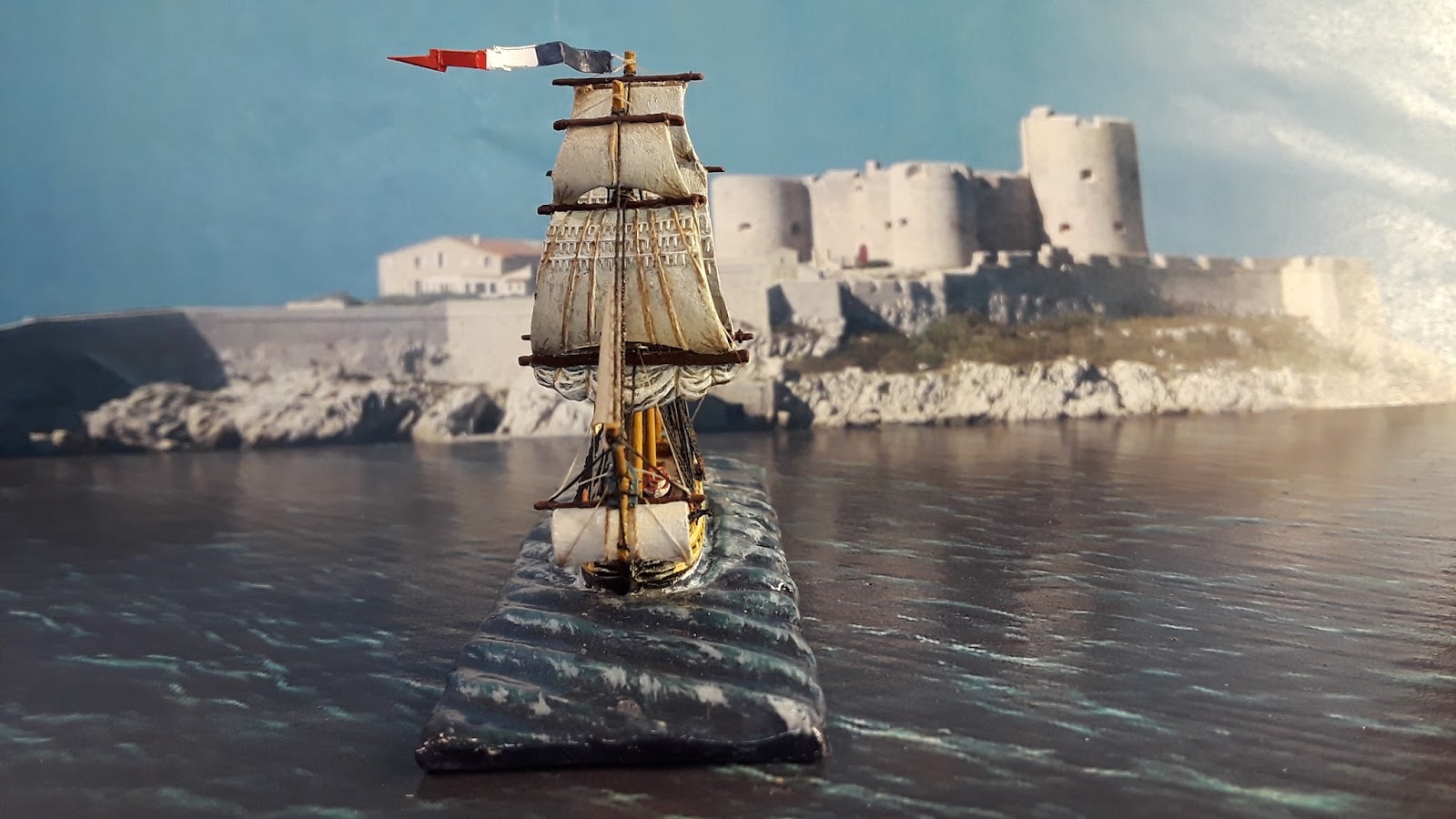
1/1200 GHQ 36-Gun Frigate HMS Révolutionnaire

This one is the GHQ 40-gun French Frigate modeled as HMS Révolutionnaire of 36-guns. Révolutionnaire was a Seine-class 40-gun French frigate launched in May of 1794. She was capture October 21st 1794, on her maiden voyage, by the 38-gun frigate HMS Artois, part of a four frigate British squadron cruising eight to ten leagues west of Ushant. She was taken into Royal service as a 36-gun 18 pounder frigate. 

Révolutionnaire

As part of a squadron commanded by Sir Edward Pellew in HMS Indefatigable, she took part in the capture and sinking of nine merchant vessels from March 11 to 21, 1796. On 12 April she captured the French frigate Unité. On May 30th 1799, she captured the French privateer Victoire, with 16 x 9 pounder guns and 160 men, after an eight hour chase. on May 29th she captured the French letter of marque brig Hyppolite. On July 7th HMS Dryad, Diamond, and Révolutionnairé captured the French privateer Determiné, armed with 18 brass 18 and 9 pounder guns along with 163 men. Then on September 19th, along with Dryad, she captured another French letter of marque Ceres, enroute from Bordeux to the Caribbean. On October 11th, after a 114 mile chase over nine and a half hours in a heavy gale, she captured the Bourdelaise with 16 x 12 pounder guns and 8 x 36 pound carronades, along with 202 men. on March 4th 1800 Révolutionnaire captured the new French privateer Coureur. In doing so she freed the Captain and most of the crew of HMS Princess Royal, which the privateer had captured earlier while sailing for Tortola.

HMS_Révolutionnaire-Antoine_Roux

British service during the Napoleonic War (the following is from Wikapedia):

Révolutionnaire was recommissioned in April 1803 under the command of Captain Walter Lock. On 20 May 1803, Révolutionnaire captured the French dogger Grand Adrian (or Grand Adrien). Two days later Révolutionnaire and Nemesis captured Alexander. The next day Révolutionnaire captured Windboud.

Lock then sailed Révolutionnaire to Gibraltar on 5 June. Eight days later, Révolutionnaire captured the French merchant vessel Hirondelle. In August, Captain Robert Hall took command for the Channel. On 16 October 1803, Révolutionnaire captured the French sloop Sophia, of eight men. Then on 1 December Révolutionnaire captured the French schooners Ceres, and her crew of 76 men, and Marian, in ballast. As the size of her crew makes clear, Ceres was a privateer. Two days later Révolutionnaire recaptured the American brig Tartar. In December, Révolutionnaire returned to Britain from the West Indies.

In April 1804 Révolutionnaire was recommissioned under Captain the Honourable Henry Hotham. By November she was off the coast of the United States and stopped in at Norfolk, Virginia. Then she sailed up to New York where she picked up $750,000 in gold to take back to Britain. Hotham would have received a commission of about 1% of the value for carrying the money.

On 1 and 4 July 1805, vessels in a squadron captured Harmony and Rachael. Révolutionnaire was one of the 39 vessels that shared in the prize money.

Révolutionnaire

On 4 November 1805, Révolutionnaire, participated in the Battle of Cape Ortegal. She and Phoenix captured Scipion, which the Royal Navy commissioned as HMS Scipion. In the battle, Révolutionnaire lost two men killed and six wounded. Révolutionnaire shared in the prize money for Formidable, Duguay Trouin and Mont Blanc, as well as Scipion. In 1847 the Admiralty awarded the Naval General Service Medal with clasp "4 Novr. 1805" to all surviving claimants form the battle.

In February 1806 Captain Charles Fielding took command as Révolutionnaire served in the Channel.

Révolutionnaire shared with Hero, Iris, and Confiance in the proceeds from the recapture on 11 January 1807 of the schooner Monarch. On 25 September she shared with Pomone in the capture of the Danish ship Resolution.

Then between October 1811 and December 1812 she underwent a major overhaul at Plymouth. She was recommissioned in October 1812 under Captain John Woolcombe (or Woollcombe). At some point Révolutionnaire sailed to North America.

Révolutionnaire recaptured Ajax, M'Kay, master, and sent her into Plymouth, where she arrived on 12 May 2013. Ajax had been sailing from Aberdeen to St Croix when the American privateer General Tompkins, of fourteen 18-pounder guns and 109 men, had captured her on 31 March.

On 25 July 1813, Révolutionnaire captured the American privateer schooner Matilda, of 190 tons. She was pierced for 18 guns but carried 11. Lion had captured Matilda in a severe action off the coast of Brazil, but the American privateer Argus, or by other accounts, the USS Argus had recaptured her. Matilda reached Plymouth on 29 July.

Already by August 1813, Révolutionnaire was part of a squadron under the command of Captain Sir George Collier. On 27 August the boats of the squadron made a successful attack on the island of Santa Clara, at the mouth of the harbour of Saint Sebastian. Révolutionnaire suffered no casualties. She then provided seamen to man a battery of 24-pounder guns from Surveillante hauled up to the top of the island. The battery then silenced the enemy's guns. In 1847 the Admiralty awarded the Naval General Service Medal with clasp "St. Sebastian" to all claimants from Collier's naval operations in the region in August and September.

On 20 October Révolutionnaire captured Fire Fly. Then on 5 November Révolutionnaire recaptured the Gaditana.

On the last day of 1813, Révolutionnaire sailed with a convoy for the East Indies. She and Zebra were in Simon's Bay on 28 July 1816 where they were stranded and almost destroyed by a terrible hurricane. On 6 October she reached St. Helena and on 13 October she sailed for Britain.

Post War and Fate:

In early 1817 Révolutionnaire underwent repairs at Plymouth. She was then fitted for sea between August 1818 and January 1819. She was commissioned under Captain Fleetwood Pellew Révolutionnaire in August 1818 for the Mediterranean.

At midnight or so on 16 December Vengeur, which was carrying the king of Naples, was under full sail when she ran into the side of Révolutionnaire. Fortunately the impact was oblique, not perpendicular, or Révolutionnaire would have been sunk. As it was, both vessels were badly damaged and had to put into the Bay of Baia for repairs.

On 18 May 1821 Révolutionnaire captured two piratical gun-boats, with bounty money for the crews being paid in 1834. Pellew remained in command until 1822.

Révolutionnaire was briefly under the command of Captain Henry Duncan, but was broken up on 4 October 1822.

The model:


Friday, February 15, 2019

GHQ French 74 Gun Redoubtable

This is another one of the GHQ #132 Temeraire hulls. This one is modeled as the French third rate ship Redoubtable. The paint scheme I used comes from the Langton Guide book example #7 on page 25: Quarterdeck gunwale stripe charcoal; upper deck stripe flat red; lower deck stripe black; basalt gray strakes; black hull.

Length of gun deck = 182 ft 6 in
Extreme breadth = 49 ft
Depth in hold = 21 ft 6 in
Tons burthen = 1929 tons
Complement = 550/650
Ordinance:
Lower gun deck = 30 x 36 pounders
Upper gun deck = 30 x 18 pounders
Quarter deck = 14 x 8 pounders
Forecastle = 6 x 8 pounders
Poop = 4 or 6 x 36 pound howitzers or carronades
Single broadside weight = 890 to a maximum of 988 pounds

(History paraphrased from The Ships of Trafalgar by Peter Goodwin)
By virtue of her association with the Victory and the death of Lord Nelson, Redoubtable is perhaps the most acclaimed French ship to fight at the battle of Trafalgar. Designed by Jacques Noel Sane and launched at Brest in 1790, Redoubtable was the third oldest ship in Villeneuve's fleet.
In 1795 she took part in the Isle de Groix action on June 23 where the British took three prizes. On 15 December, 1796 Redoubtable sailed from Brest for Ireland with a large fleet of 44 warships and transports with 18,000 troops commanded by General Hoche, The intention was to land these forces and incite rebellion in Ireland, The expedition failed and Redoubtable, with Indomptable, Fogueux, Mucius, and Patriote returned to Brest on 1 January 1797.

Redoubtable did not join Villeneuve's combined fleet until it entered Ferrol on August 1, 1805. Eight days later she sailed with the squadron and entered Cadiz on August 20. The combined fleet sailed from Cadiz on 19 October. At 7 a.m. on the 21st VIlleneuve ordered the fleet to wear together and come to a starboard tack back towards Cadiz. Redoubtable's position was now 13th in line from the head of Villeneuve's line. Ahead of her starboard bow was Neptune (84), astern San Leandro (74), and just off her starboard quarter, the frigate Hortense (40).  When the battle opened Redoubtable's gunners concentrated their fire upon Victory as she made her approach. As Neptune veered off to leeward causing a large gap to open behind Villeneuve's flagship, Captain Lucas directed Redoubtable to move up to close the gap and prevent Victory from breaking through. In doing so her flying jib boom ran over Bucentaure's taffrail. Regardless Victory drove through, firing a devastating broadside through Bucentaure's stern and at the same time running aboard Redoubtable on her larboard bow. It was now about 1:10 p.m. and locked in combat the two ships drifted leeward. To prevent boarding through the lower deck, Captain Lucas ordered the lower gun deck port lids closed. He then concentrated fire into Victory  from his main deck guns. This, supported by a hail of musketry fire from Redoubtable's fore, main and mizzen tops took out most of Victory's upper deck guns. Besides showering Victory's deck with grenades, 200 in all, Lucas had brass cohorns mounted in his tops which, loaded with grape, inflicted high casualties within the British ship. At about 1:25 one of the sharpshooters stationed in Redoubtable's mizzen tops shot Lord Nelson from a distance of only 15 yards. Mortally wounded the Admiral was taken below decks. The unrelenting fire from Redoubtable killed most of those remaining on Victory's open decks. Victory's higher sides proved problematic to Redoubtable's boarding crews. Lucas ordered the main yard to be lowered to form a bridge for his men to cross. It was now about 1:40 p.m. and as his men massed themselves for a second boarding attempt, they received a murderous fire of grapeshot from the upper deck carronades of the Temeraire drawing up on Redoubtable's starboard side. More than two hundred crew were killed. Lucas sent the remainder back below to re-man the guns and engage Temeraire. Lucas tenaciously continued to fight the Temeraire to starboard and Victory, using whatever guns remained. Redoubtable's main and mizzen masts had gone by the board and fires had broken out on her bowsprit and forecastle. She was further hampered when Temeraire's main mast fell across her deck. Victory's gunners had depressed their guns to prevent firing through Redoubtable and hitting Temeraire. This fire ripped her lower gun and orlop decks to pieces. Out gunned by two three deck ships, Lucas struck his colours at 2:30 p.m. Of her 643 complement, there were 300 dead and 222 badly wounded among whom were all the senior and ten junior officers. Under tow during the storm on the 22nd, she started taking on water. The prize crew signaled distress and were taken off, with most of the prisoners that were mobile, by boats from HMS Swiftsure. At 10:13 Redoubtable went down with all of the wounded on board. Of the total compliment, 169 survived.


Saturday, April 21, 2018

GHQ 80 Gun French SOL Indomptable

I just finished another ship of the line for my growing French fleet, this time a GHQ Sane-Border class 80 gun ship Indomptable. Her sister ships were Bucentaure, Neptune and Formidable. She would also have been similar to the Tonnant which fought on the British side at Trafalgar. Designed by Jacques Noel Sane, Indomptable was laid down at Brest dockyard, launched in 1788 and completed in 1790.

In 1794, under command of Admiral Villaret-Joyeuse, Indomptable put to sea on May 16 with 24 other ships of the line, several frigates and corvettes. Their mission was to meet and escort a merchant fleet coming from America carrying much needed grain and other essentials vital to the French economy. On the way they captured a Dutch Lisbon convoy. British Rear-Admiral Montague pursued Villaret with a small fleet. Meanwhile Admiral Howe's larger British fleet was racing to join Montague for support and confronted Villaret first on May 28. Indomptable was not directly involved. There was a second action at 8 a.m. the following day, however it was not until 1:30 p.m. that Indomptable came under fire from Vice-Admiral Hood's Royal George (100) and Rear-Admiral Gardner's flagship Queen (98). During this engagement Indomptable and Tyrannicide suffered considerable damage. Indomptable was then engaged by Barfleur (98) and Orion (74). Despite suffering further damage and increasing casualties, Indomptable continued to fight on for over an hour with her colors flying until she and Terrible were rescued by Villaret's ships driving down to give assistance. Severely damaged she was sent home escorted by Monte Blanc.

Indomptable took part in the ill fated expedition to Ireland in 1796. On July 6, 1801 Indomptable, Formidable (80), Desaix (74), and Muiron (40)  had sailed through the Straits of Gibraltar and anchored off Algeciras. At that position they were attacked by Rear-Admiral Sir James Saumarez's squadron of five ships: Caesar (80), and 74's Audacious, Hannibal, Pompee and Spencer. During the action Indomptable ran aground trying to warp further in shore. For two hours the firing was heavy on both sides both Captains Moncousu of Indomptable and Lalonde of Formidable were killed. The attack was unsuccessful as the French ships were well supported by shore batteries.

Trafalgar: On October 21, 1805 Indomptable lay at the center, seventeenth from the van of Villeneuve's combined Spanish and French fleet. Ahead on her larboard bow lay Santa Ana (112), on her starboard bow San Justo (74) and astern on her larboard quarter Fogueux (74). Indomptable started firing her larboard broadside just before noon at Collingwood's approaching Leeward Division. As Collingwood's Royal Sovereign (100) crossed the stern of Santa Ana and ranged up on Santa Ana's starboard side, Indomptable raked Royal Sovereign and continued firing into her starboard quarter from a distance of 500 yards. After Belleisle (74) had crossed and raked the Santa Ana in turn she then ported her helm and turned across Indomptable's stern to rake her. Fougueux intervened and poured a couple of broadsides into Belleisle. Suffering few casualties, Captain Hubert chose to carry Indomptable away from the battle and made for Cadiz at close to 1 p.m.

On October 23 Indomptable took part in Commodore Cosmao-Kerjulien's rescue attempt of the damaged British prizes from the battle. In company were Neptune, Pluton, Rayo, and San Francisco de Asis, along with frigates Cornelie, Hemione, Hortense, Rhin, Themis, and the brigs Argus and Furet. After clearing the harbor the wind rose to gale force. As the French approached, ten British ships cast off their tow lines and formed line of battle. Kerjulien's ships were outnumbered and damaged, but the frigates managed to retake Santa Ana and Neptuno. Indomptable took on Bucentaure's 500 survivors before turning back for Cadiz. The next morning on October 24, Indomptable ran aground off Rota and, battered by the heavy seas, she quickly broke apart with terrible loss of life. Including those taken off Bucentaure, nearly 1,000 men perished.

Length of Gun Deck = 194'
Beam = 51'4-1/2"
Depth in Hold = 23'2"
Tons Burthen = 2231
Complement = 690

Armament:
Lower Gun Deck = 30 x 36 pounders
Upper Gun Deck = 32 x 24 pounders
Quarter Deck = 12 x 8 pounders
Forecastle = 6 x 8 pounders
Poop Deck = 6 x 36 pound Howitzers
Single Broadside Weight = 1112 pounds

Here is the completed model. The foremast and mizzen with sails are GHQ with the lower masts replaced with music wire. The mainmast is scratch built with Davco sails. The bow sprit and stay sails are scratch built.


References: The Ships of Trafalgar - The British, French and Spanish Fleets October 1805 by Peter Goodwin - Keeper and Curator of HMS Victory

Wednesday, April 19, 2017

GHQ Téméraire class 74 gun Le Fougueux

I took a break from my American fleet to build another French ship of the line. This is the GHQ version of a Téméraire class 74 gun ship Le Fouguex. Launched in 1785 at Lorient, she took part in the First Battle of Groix in 1795. In the battle of Trafalgar she fired the first shot at HMS Royal Sovereign. She was captured by HMS Temeraire and wrecked in the storm that followed the battle. She displaced 1,966 tons and had a crew of 700. Length of gun deck = 183'3" imperial; Breadth = 47' imperial; Depth of Hold 23'5" imperial.
Armament: Broadside Weight 881 lbs
     Lower Gun Deck = 28 x French 36 pounders
     Upper Gun Deck = 30 x French 18 pounders
     Quarterdeck = 16 x French 8 pounders
     Forecastle = 4 French 36 pounders carronades


Monday, December 26, 2016

1/1200 GHQ USS Constellation

Here for your viewing pleasure (I hope) is GHQ's version of the 38-gun USS Constellation. One of the original six Humphreys frigates authorized by Congress in 1794, Constellation and Congress were designed as 36-gun frigates. They were over sized for their ratings. The keels for Constellation and Congress were 135 ft long, with a 163 ft gun deck. Contemporary British 36 gun frigates had a gun deck that was 137 ft in length, and the 38-gun British frigates rarely exceeded an overall length of 150 ft. Even Pomone, a French 44-gun frigate, had a 159 ft gun deck. Humphreys designed these ships to mount 28 18-pdr long guns on the gun deck, and eight 9-pdrs on the spar deck. As designed, it would have given them a punch greater than the standard British 38-gun frigate, but in actual practice, both ships carried more and heavier guns on their spar deck than their design specified.

As modeled:
L=163'; B=41'; DH=13.5'; 1,265 tons burthen; Crew=340

Armament:
28 x 18pdr long guns on gun deck
20 x 32pdr carronades on spar deck

My inspiration painting:

Standing rigging


Finished Model


Not sure what I'm doing next. Until next post........